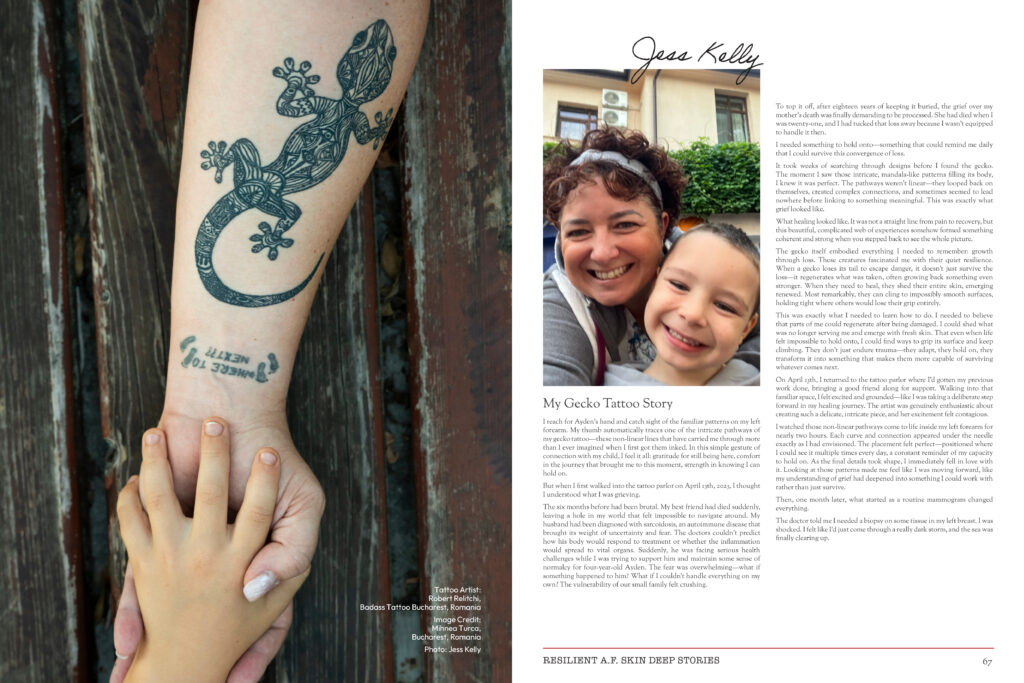
My Gecko Tattoo Story
I reach for Ayden’s hand and catch sight of the familiar patterns on my left forearm. My thumb automatically traces one of the intricate pathways of my gecko tattoo—these non-linear lines that have carried me through more than I ever imagined when I first got them inked. In this simple gesture of connection with my child, I feel it all: gratitude for still being here, comfort in the journey that brought me to this moment, strength in knowing I can hold on.
But when I first walked into the tattoo parlor on April 13th, 2023, I thought I understood what I was grieving.
The six months before had been brutal. My best friend had died suddenly, leaving a hole in my world that felt impossible to navigate around. My husband had been diagnosed with sarcoidosis, an autoimmune disease that brought its weight of uncertainty and fear. The doctors couldn’t predict how his body would respond to treatment or whether the inflammation would spread to vital organs. Suddenly, he was facing serious health challenges while I was trying to support him and maintain some sense of normalcy for four-year-old Ayden. The fear was overwhelming—what if something happened to him? What if I couldn’t handle everything on my own? The vulnerability of our small family felt crushing.
To top it off, after eighteen years of keeping it buried, the grief over my mother’s death was finally demanding to be processed. She had died when I was twenty-one, and I had tucked that loss away because I wasn’t equipped to handle it then.
I needed something to hold onto—something that could remind me daily that I could survive this convergence of loss.
It took weeks of searching through designs before I found the gecko. The moment I saw those intricate, mandala-like patterns filling its body, I knew it was perfect. The pathways weren’t linear—they looped back on themselves, created complex connections, and sometimes seemed to lead nowhere before linking to something meaningful. This was exactly what grief looked like.
What healing looked like. It was not a straight line from pain to recovery, but this beautiful, complicated web of experiences somehow formed something coherent and strong when you stepped back to see the whole picture.
The gecko itself embodied everything I needed to remember: growth through loss. These creatures fascinated me with their quiet resilience. When a gecko loses its tail to escape danger, it doesn’t just survive the loss—it regenerates what was taken, often growing back something even stronger. When they need to heal, they shed their entire skin, emerging renewed. Most remarkably, they can cling to impossibly smooth surfaces, holding tight where others would lose their grip entirely.
This was exactly what I needed to learn how to do. I needed to believe that parts of me could regenerate after being damaged. I could shed what was no longer serving me and emerge with fresh skin. That even when life felt impossible to hold onto, I could find ways to grip its surface and keep climbing. They don’t just endure trauma—they adapt, they hold on, they transform it into something that makes them more capable of surviving whatever comes next.
On April 13th, I returned to the tattoo parlor where I’d gotten my previous work done, bringing a good friend along for support. Walking into that familiar space, I felt excited and grounded—like I was taking a deliberate step forward in my healing journey. The artist was genuinely enthusiastic about creating such a delicate, intricate piece, and her excitement felt contagious.
I watched those non-linear pathways come to life inside my left forearm for nearly two hours. Each curve and connection appeared under the needle exactly as I had envisioned. The placement felt perfect—positioned where I could see it multiple times every day, a constant reminder of my capacity to hold on. As the final details took shape, I immediately fell in love with it. Looking at those patterns made me feel like I was moving forward, like my understanding of grief had deepened into something I could work with rather than just survive.
Then, one month later, what started as a routine mammogram changed everything.
The doctor told me I needed a biopsy on some tissue in my left breast. I was shocked. I felt like I’d just come through a really dark storm, and the sea was finally clearing up.
As I looked out on the horizon of my life, I could see calmer waters ahead. But suddenly, I spotted an even bigger, more ominous storm approaching—one that looked like it might swallow me entirely. I didn’t know if I had the strength to navigate it.
After a week of waiting that felt like a lifetime, I received the official diagnosis: triple-positive invasive breast cancer. This sent our family into full survival mode. How would we get treatment living in Romania? Would it be good? Could I get the care I needed to beat this? In the following weeks, I prepared for a single mastectomy surgery. After recovering from that, I started chemotherapy and immunotherapy treatments once a week for twelve weeks, followed by radiation treatment five days a week for five weeks. This entire grueling process ended just two weeks before my 40th birthday.
This was grief of an entirely different kind. Grief for my own body, my sense of safety, my future. Suddenly, I wasn’t just processing the losses I already knew—I was facing my own mortality.
Now, both of Ayden’s parents were facing serious health challenges simultaneously. The fear was paralyzing—what if something happened to both of us? Who would take care of him? The vulnerability of our small family felt crushing. Here I was, about to start intensive cancer treatment, while my husband was still managing his autoimmune disease. The logistics alone were overwhelming: coordinating our medical appointments, managing side effects from different treatments, trying to maintain some sense of normalcy for a four-year-old who couldn’t fully understand why both Mommy and Daddy were sick. Thankfully, my husband’s parents stepped in and showed up for us. They coordinated their flights from America and were there to support us. His mom came for my surgery and recovery, his step-mom and father came to help during chemo, and his mom returned to help during the radiation. They were truly amazing.
But it also really helps that I already had my anchor etched into my skin.
During the long chemotherapy sessions, when exhaustion and fear felt overwhelming, I would look down at those non-linear patterns and remember: this is how healing works. There’s no straight path through any of this, but there is a path. When the hardest appointments made me feel like I was losing my grip on everything, I would run my thumb along the gecko’s pathways and feel steadied.
Two years cancer-free now, I continue to use the gecko as my anchor through the ongoing process of healing. Because that’s what I’ve learned—resilience isn’t a destination you reach. It’s a daily practice of holding on, adapting, growing through whatever loss the world hands you.
The meaning of my gecko has deepened with time. What started as a reminder to survive has become a celebration of thriving. My husband’s sarcoidosis is well-managed now, and watching Ayden grow into a vibrant six-year-old fills me with gratitude for all the moments I fought to be here still to witness. Some mornings, when I catch sight of those intricate patterns during routine activities—making his breakfast, helping him get dressed—I’m struck by how ordinary these precious moments are. The gecko reminds me that healing isn’t just about getting through the hardest days; it’s about being present for all the quiet, beautiful ones that follow.
I reach for Ayden’s hand again, and the gecko catches the light. All those intricate pathways that seemed so chaotic when I was in the thick of each crisis now form this coherent reminder: I survived. I’m still here. And just like the gecko, I can hold on to what matters most.
Resilience isn’t bouncing back to who you were before—it’s growing into who you need to become through loss. Sometimes you’re not ready to process something when it happens, and that’s okay. Sometimes resilience is delayed, sometimes immediate. Both are valid. Real resilience is messy, non-linear, and ongoing. It’s about developing tools that help you hold on when everything feels impossible to grip.
My advice for anyone navigating loss is to trust your instincts about what you need, even when you don’t understand why. I got my gecko tattoo thinking I was processing known grief, but it became exactly what I needed for Cancer a month later. Part of us often know before our conscious mind catches up. Create daily practices that anchor you. Find something that reminds you of your strength or ability to keep going. It could be jewelry, a photo, a mantra—anything that serves as a touchstone when you need steadying.
Remember that healing isn’t linear, and that’s not failure. You’ll loop back to places you thought you’d moved past. You’ll have setbacks and discover new layers of old wounds. This isn’t regression—it’s how healing works. Those pathways eventually connect to form something coherent and strong.
Are you ready to share your story of RESILIENCE? You can do that HERE.