
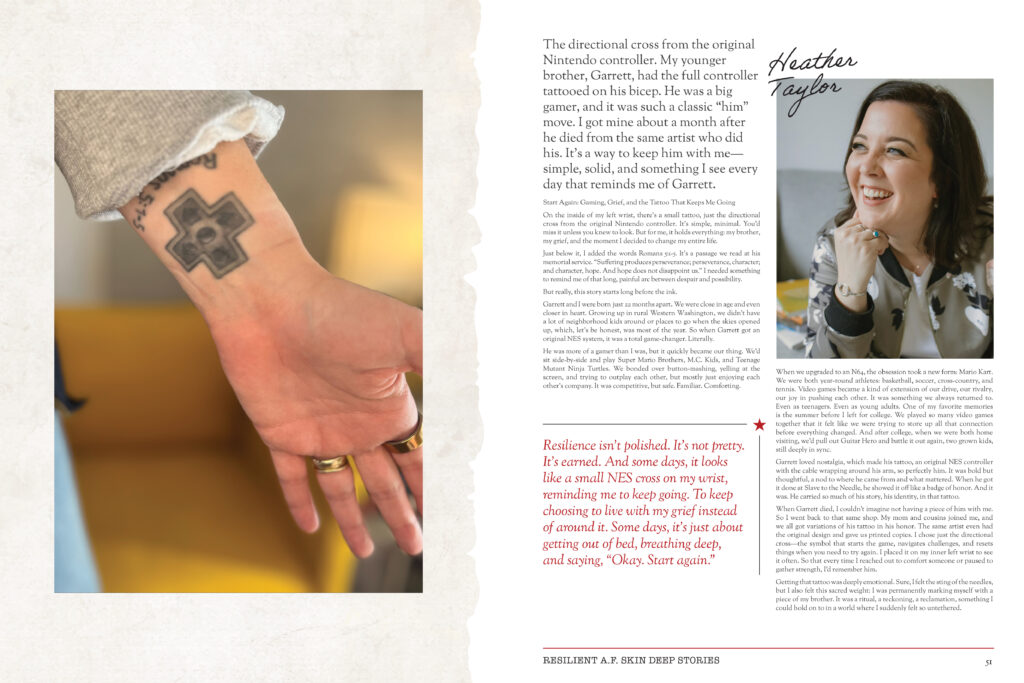
The directional cross from the original Nintendo controller. My younger brother, Garrett, had the full controller tattooed on his bicep. He was a big gamer, and it was such a classic “him” move. I got mine about a month after he died from the same artist who did his. It’s a way to keep him with me—simple, solid, and something I see every day that reminds me of Garrett.
Start Again: Gaming, Grief, and the Tattoo That Keeps Me Going
On the inside of my left wrist, there’s a small tattoo, just the directional cross from the original Nintendo controller. It’s simple, minimal. You’d miss it unless you knew to look. But for me, it holds everything: my brother, my grief, and the moment I decided to change my entire life.
Just below it, I added the words Romans 5:1-5. It’s a passage we read at his memorial service. “Suffering produces perseverance; perseverance, character; and character, hope. And hope does not disappoint us.” I needed something to remind me of that long, painful arc between despair and possibility.
But really, this story starts long before the ink.
Garrett and I were born just 22 months apart. We were close in age and even closer in heart. Growing up in rural Western Washington, we didn’t have a lot of neighborhood kids around or places to go when the skies opened up, which, let’s be honest, was most of the year. So when Garrett got an original NES system, it was a total game-changer. Literally.
He was more of a gamer than I was, but it quickly became our thing. We’d sit side-by-side and play Super Mario Brothers, M.C. Kids, and Teenage Mutant Ninja Turtles. We bonded over button-mashing, yelling at the screen, and trying to outplay each other, but mostly just enjoying each other’s company. It was competitive, but safe. Familiar. Comforting.
When we upgraded to an N64, the obsession took a new form: Mario Kart. We were both year-round athletes: basketball, soccer, cross-country, and tennis. Video games became a kind of extension of our drive, our rivalry, our joy in pushing each other. It was something we always returned to. Even as teenagers. Even as young adults. One of my favorite memories is the summer before I left for college. We played so many video games together that it felt like we were trying to store up all that connection before everything changed. And after college, when we were both home visiting, we’d pull out Guitar Hero and battle it out again, two grown kids, still deeply in sync.
Garrett loved nostalgia, which made his tattoo, an original NES controller with the cable wrapping around his arm, so perfectly him. It was bold but thoughtful, a nod to where he came from and what mattered. When he got it done at Slave to the Needle, he showed it off like a badge of honor. And it was. He carried so much of his story, his identity, in that tattoo.
When Garrett died, I couldn’t imagine not having a piece of him with me. So I went back to that same shop. My mom and cousins joined me, and we all got variations of his tattoo in his honor. The same artist even had the original design and gave us printed copies. I chose just the directional cross—the symbol that starts the game, navigates challenges, and resets things when you need to try again. I placed it on my inner left wrist to see it often. So that every time I reached out to comfort someone or paused to gather strength, I’d remember him.
Getting that tattoo was deeply emotional. Sure, I felt the sting of the needles, but I also felt this sacred weight: I was permanently marking myself with a piece of my brother. It was a ritual, a reckoning, a reclamation, something I could hold on to in a world where I suddenly felt so untethered.
Garrett wasn’t just my brother. He was my cheerleader, my champion, my compass.
I remember one specific moment after college: I was home for a visit. I felt completely lost, with no sense of direction or plan for what was next. I’ve always been someone with a goal, a roadmap. I had finished my bachelor’s degree and ended a relationship. I felt alone, overwhelmed, and at a crossroads for where to take my life next, and I struggled to believe in myself.
Garrett was in his room gaming, headphones on, controller in hand, and I walked in and started venting. He paused his game, turned to me, and said with total conviction: “You’re a fucking Taylor. Do what you want to do. And don’t take any crap from anybody about what that looks like. You’re better than that.”
That moment lives in my bones. I hear his voice when I doubt myself, feel like I’m failing or floundering. I feel that nudge. And now, every time I look at that tattoo, it’s not just about memory, it’s about direction. It’s about believing in myself, even when it’s hard, especially when it’s hard.
After Garrett died, I tried to keep functioning. I started running to help with my mental health because it was one of the few things that quieted the mental chaos. But I was drowning. There were no grief resources that spoke to my experience, especially as a grieving sibling. It was like we didn’t exist in the grief world. There were books for grieving parents, spouses, and children. But siblings? Silence.
Eventually, I tried therapy. I thought maybe talking to someone would help me find my footing. I wasn’t sure yet if I wanted to become a therapist, but I was curious and desperate for something that might make the pain less overwhelming.
I met with three different clinicians.
None of them knew how to support sibling grief. They didn’t ask about Garrett. They didn’t understand the pain of losing someone who helped define your identity. And one of them (this still blows my mind) put in a VHS tape about grief during the session instead of talking to me. I just sat there, watching grainy footage from the ‘90s, feeling completely unseen. It was surreal. It was infuriating.
That moment, sitting in the parking lot afterward, shaking with disappointment and rage, was the final push. If that was the state of grief support, we needed to do better. I decided then and there to go back to school. I wanted to become a grief therapist—not just in title but in practice. I wanted to hold space for people the way I had needed someone to hold space for me.
Now, years later, that tattoo is my anchor. It’s a symbol of continuing bonds, a concept in grief theory that emphasizes maintaining a relationship with the person who died, rather than “letting go.” It’s also a deeply personal form of meaning-making. Clinically, we know that memorial tattoos help the bereaved integrate their grief into identity and body. They externalize what feels too big to hold inside.
But this isn’t just theory, it’s lived experience.
That cross on my wrist reminds me to keep going. It reminds me that Garrett is still with me. His voice, laughter, and belief in me didn’t disappear; they just shifted. And now I carry that forward in my work, the people I support, and the legacy I’ve built because of him.
And my advice to anyone grieving a sibling?
Sibling loss is rarely discussed, which only adds to the loneliness. And you are not alone. Your grief is real. Your memories matter. And you deserve space to say their name, tell their story, and figure out who you are now.
So let your grief matter. Talk about them. Say their name. Write their stories down. Find rituals that help you make space for your grief. Try grief coaching or therapy; don’t be afraid to leave if it’s not helping. You deserve to be met where you are. The right support will see you, not fix you.
Get the tattoo if it calls to you. Wear the hoodie. Make memorial jewelry. Play the damn video game. Do what connects you to their memory and your healing.
You’re not broken. You’re grieving. And you’re allowed to do that in your own way, in your own time. There’s no right path, just the one that helps you keep going. And if you need a sign to take the next step, let this be it.
So what does being Resilient A.F. mean to me?
It means standing in the wreckage of a life you never imagined you’d have to live and figuring out how to keep going anyway. Not because it feels good. Not because you’re ready. But because you don’t have another choice, that feels more honest.
It’s letting grief rip you open and then learning how to live inside the version of yourself that comes after. It’s figuring out how to build a life that makes space for what you lost and who you are now, even when the world around you wants you to tie it up with a bow and “move on.”
Being Resilient A.F. doesn’t mean pushing through. It doesn’t mean pretending you’re fine. It means stopping when you need to, grieving as long as it takes, and choosing again. It’s building something that matters from the mess. It’s turning pain into something useful, not because you wanted to, but because staying stuck wasn’t an option.
For me, resilience meant becoming the grief therapist I couldn’t find when I was drowning. The one who doesn’t hand you a worksheet or a VHS tape. The one who says your person’s name. Who sits in the quiet with you. Who doesn’t flinch. It meant doing the hard, human work of showing up for others in the exact way I needed someone to show up for me.
Resilience isn’t polished. It’s not pretty. It’s earned. And some days, it looks like a small NES cross on my wrist, reminding me to keep going. To keep choosing to live with my grief instead of around it. Some days, it’s just about getting out of bed, breathing deep, and saying, “Okay. Start again.”
Are you ready to share your story of RESILIENCE? You can do that HERE.