Always know that I am proud of you and that your loved ones who are no longer with us are proud of you, too.
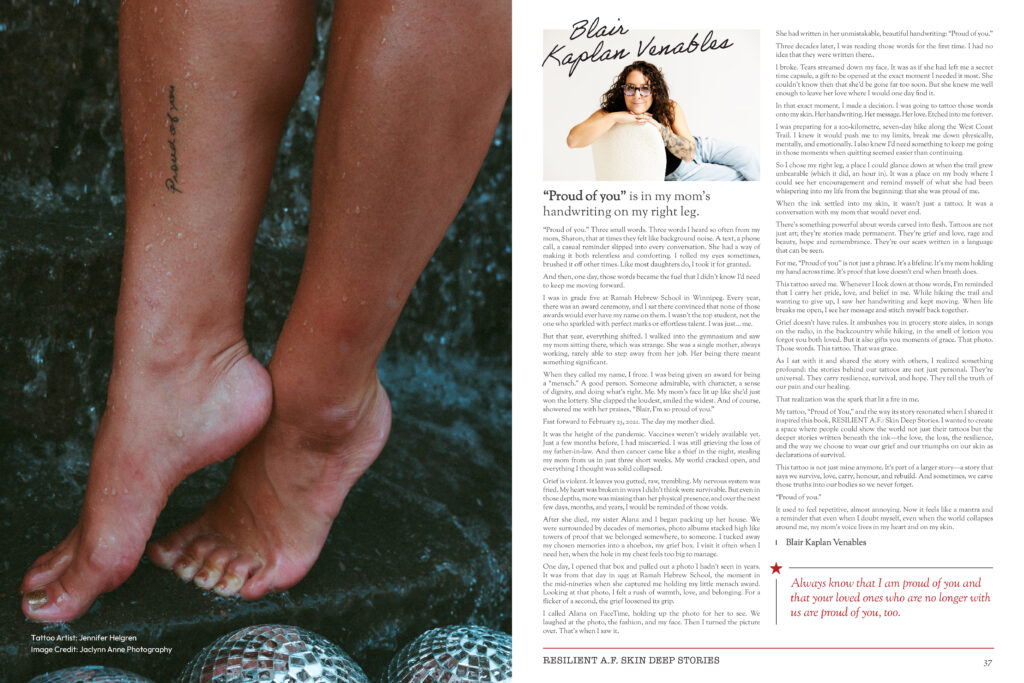
“Proud of you” is in my mom’s handwriting on my right leg.
“Proud of you.” Three small words. Three words I heard so often from my mom, Sharon, that at times they felt like background noise. A text, a phone call, a casual reminder slipped into every conversation. She had a way of making it both relentless and comforting. I rolled my eyes sometimes, brushed it off other times. Like most daughters do, I took it for granted.
And then, one day, those words became the fuel that I didn’t know I’d need to keep me moving forward.
I was in grade five at Ramah Hebrew School in Winnipeg. Every year, there was an award ceremony, and I sat there convinced that none of those awards would ever have my name on them. I wasn’t the top student, not the one who sparkled with perfect marks or effortless talent. I was just… me.
But that year, everything shifted. I walked into the gymnasium and saw my mom sitting there, which was strange. She was a single mother, always working, rarely able to step away from her job. Her being there meant something significant.
When they called my name, I froze. I was being given an award for being a “mensch.” A good person. Someone admirable, with character, a sense of dignity, and doing what’s right. Me. My mom’s face lit up like she’d just won the lottery. She clapped the loudest, smiled the widest. And of course, showered me with her praises, “Blair, I’m so proud of you.”
Fast forward to February 23, 2021. The day my mother died.
It was the height of the pandemic. Vaccines weren’t widely available yet. Just a few months before, I had miscarried. I was still grieving the loss of my father-in-law. And then cancer came like a thief in the night, stealing my mom from us in just three short weeks. My world cracked open, and everything I thought was solid collapsed.
Grief is violent. It leaves you gutted, raw, trembling. My nervous system was fried. My heart was broken in ways I didn’t think were survivable. But even in those depths, more was missing than her physical presence, and over the next few days, months, and years, I would be reminded of those voids.
After she died, my sister Alana and I began packing up her house. We were surrounded by decades of memories, photo albums stacked high like towers of proof that we belonged somewhere, to someone. I tucked away my chosen memories into a shoebox, my grief box. I visit it often when I need her, when the hole in my chest feels too big to manage.
One day, I opened that box and pulled out a photo I hadn’t seen in years. It was from that day in 1995 at Ramah Hebrew School, the moment in the mid-nineties when she captured me holding my little mensch award. Looking at that photo, I felt a rush of warmth, love, and belonging. For a flicker of a second, the grief loosened its grip.
I called Alana on FaceTime, holding up the photo for her to see. We laughed at the photo, the fashion, and my face. Then I turned the picture over. That’s when I saw it.
She had written in her unmistakable, beautiful handwriting: “Proud of you.”
Three decades later, I was reading those words for the first time. I had no idea that they were written there..
I broke. Tears streamed down my face. It was as if she had left me a secret time capsule, a gift to be opened at the exact moment I needed it most. She couldn’t know then that she’d be gone far too soon. But she knew me well enough to leave her love where I would one day find it.
In that exact moment, I made a decision. I was going to tattoo those words onto my skin. Her handwriting. Her message. Her love. Etched into me forever.
I was preparing for a 100-kilometre, seven-day hike along the West Coast Trail. I knew it would push me to my limits, break me down physically, mentally, and emotionally. I also knew I’d need something to keep me going in those moments when quitting seemed easier than continuing.
So I chose my right leg, a place I could glance down at when the trail grew unbearable (which it did, an hour in). It was a place on my body where I could see her encouragement and remind myself of what she had been whispering into my life from the beginning: that she was proud of me.
When the ink settled into my skin, it wasn’t just a tattoo. It was a conversation with my mom that would never end.
There’s something powerful about words carved into flesh. Tattoos are not just art; they’re stories made permanent. They’re grief and love, rage and beauty, hope and remembrance. They’re our scars written in a language that can be seen.
For me, “Proud of you” is not just a phrase. It’s a lifeline. It’s my mom holding my hand across time. It’s proof that love doesn’t end when breath does.
This tattoo saved me. Whenever I look down at those words, I’m reminded that I carry her pride, love, and belief in me. While hiking the trail and wanting to give up, I saw her handwriting and kept moving. When life breaks me open, I see her message and stitch myself back together.
Grief doesn’t have rules. It ambushes you in grocery store aisles, in songs on the radio, in the backcountry while hiking, in the smell of lotion you forgot you both loved. But it also gifts you moments of grace. That photo. Those words. This tattoo. That was grace.
As I sat with it and shared the story with others, I realized something profound: the stories behind our tattoos are not just personal. They’re universal. They carry resilience, survival, and hope. They tell the truth of our pain and our healing.
That realization was the spark that lit a fire in me.
My tattoo, “Proud of You,” and the way its story resonated when I shared it inspired this book, RESILIENT A.F.: Skin Deep Stories. I wanted to create a space where people could show the world not just their tattoos but the deeper stories written beneath the ink—the love, the loss, the resilience, and the way we choose to wear our grief and our triumphs on our skin as declarations of survival.
This tattoo is not just mine anymore. It’s part of a larger story—a story that says we survive, love, carry, honour, and rebuild. And sometimes, we carve those truths into our bodies so we never forget.
“Proud of you.”
It used to feel repetitive, almost annoying. Now it feels like a mantra and a reminder that even when I doubt myself, even when the world collapses around me, my mom’s voice lives in my heart and on my skin.
Are you ready to share your story of RESILIENCE? You can do that HERE.